VW ID.4 vs. Tesla Model Y: Which EV Makes Sense in Houston?
Compare the 2026 VW ID.4 and Tesla Model Y on price, range, charging, and comfort — with a Houston-specific take on which EV fits your driving life.
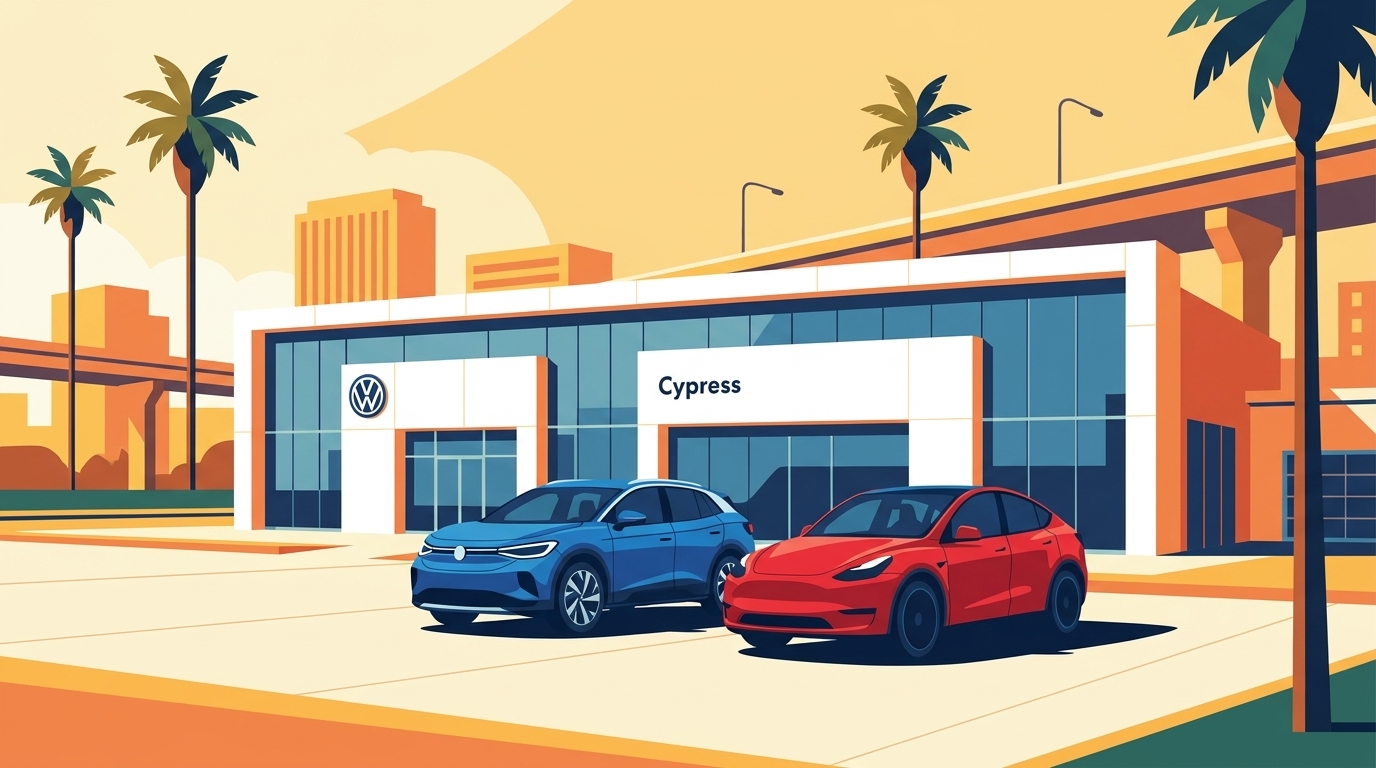
You're shopping for an electric SUV in Houston, and two names keep surfacing: the 2026 Volkswagen ID.4 and the 2026 Tesla Model Y. They're the default answers for good reason — both seat five, both offer rear- or all-wheel drive, and both can handle a daily commute from Katy to downtown without breaking a sweat. But they're built around very different philosophies, and the right choice depends on how you drive, where you charge, and what you value behind the wheel.
Here's a clear-eyed comparison built around the specs that actually matter, with a Houston lens on charging, climate, and dealer dynamics.
Price: Sticker vs. What You'll Actually Pay
On paper, the Tesla Model Y starts below the 2026 Volkswagen ID.4, which carries a base MSRP before destination charges. That's a meaningful gap in Tesla's favor at sticker price.
But MSRP isn't the whole story. Tesla uses fixed direct-to-consumer pricing, so what you see online is what you pay — and Tesla's prices shift frequently, so any published figure is a snapshot. Volkswagen dealers in the Houston metro frequently discount ID.4 inventory, and manufacturer incentives can narrow or even close the gap depending on trim, timing, and what's currently on the lot. If you're cross-shopping, contact Volkswagen Cypress for a real out-the-door number before assuming Tesla wins on price.
Confirm current credit eligibility at the time of purchase, since rules can change.
Range and Efficiency: Tesla's Clear Edge
For Houston drivers who regularly run I-10 to San Antonio or US-290 to College Station, range matters.
The 2026 Model Y leads on EPA-estimated range across most trim comparisons. The Premium RWD reaches up to 357 miles, while the Standard RWD comes in at 321 miles. AWD versions offer strong range as well, varying by configuration.
The 2026 ID.4 tops out at 291 miles on the single-motor RWD, with AWD versions rated lower. The ID.4 uses an 82 kWh gross battery, and range varies by trim and driving conditions.
Efficiency follows the same pattern. The Model Y Standard RWD leads among comparable drivetrains, and the ID.4 RWD trails by a notable margin. In Houston's stop-and-go traffic around the Galleria or the 610 Loop, that efficiency gap translates to real dollars saved at the plug over time.
One caveat: EPA figures are lab estimates. Real-world range during a Houston August — with the A/C working overtime — will be lower for both vehicles. Plan for meaningful reduction from the sticker number on the hottest days.
Charging: Supercharger Reach vs. Broad Network Access
This is where Houston geography matters most.
The Model Y uses Tesla's NACS plug and taps into the Supercharger network, which remains the most reliable fast-charging system along Texas intercity corridors. Tesla quotes approximately 144 miles added in 15 minutes on the Performance AWD at a Supercharger — other trims vary. There is no included free charging; you pay per session.
The ID.4 uses CCS and supports DC fast charging at up to 170 kW, along with an 11 kW AC onboard charger. VW has historically included complimentary Electrify America DC fast-charging sessions with new ID.4 purchases — confirm current program details and terms at the time of purchase, as they are subject to change. For drivers who live near an EA station and rarely road-trip, that can be a meaningful operating-cost advantage.
The non-Tesla charging landscape is evolving, but for frequent drives to Austin, Dallas, or the Hill Country, Tesla's network remains the more dependable bet.
Performance and Driving Feel
The ID.4 produces 282 hp in RWD form and 335 hp in AWD. The Model Y Performance AWD is manufacturer-estimated at 3.3 seconds to 60 mph — significantly quicker than any ID.4 configuration. Tesla does not publish official horsepower figures; third-party estimates place RWD versions near 300 hp and AWD versions higher, but these should not be treated as manufacturer specifications.
But raw numbers don't capture the experience. The ID.4 rides more compliantly — a real benefit on Houston's patched concrete freeways and uneven surface streets in older neighborhoods like the Heights or Montrose. It uses traditional physical controls, wireless Apple CarPlay and Android Auto, and generally feels more refined for a long commute. The Model Y is sportier and stiffer, with a screen-centric interface that some drivers love and others find distracting.
If your priority is comfort and conventional ergonomics, the ID.4 has the edge. If you want maximum acceleration and a minimalist tech experience, the Model Y wins.
Cargo, Towing, and Practicality
The Model Y offers approximately 33 cubic feet behind the rear seats and up to roughly 75–76 cubic feet maximum, including a front trunk the ID.4 lacks. Note that measurement methods differ between brands, making direct comparison approximate.
The ID.4 offers 30.3 cubic feet behind the second row and 64.2 cubic feet maximum. On towing, the ID.4 carries a published factory rating of up to 2,700 lb when properly equipped. A confirmed towing rating for the Model Y is not established by the sources available; buyers who need to tow should verify the exact configuration, tow package availability, and rated capacity directly with Tesla before purchasing.
The ID.4 seats five. The Model Y seats five as standard, with a reported seven-seat option on select trims.
Warranty Coverage
Both vehicles come with 4-year/50,000-mile basic coverage. The ID.4's high-voltage battery warranty runs 8 years/100,000 miles, with roadside assistance included for 3 years/36,000 miles. The Model Y's battery and drive unit warranty runs 8 years with a mileage limit that varies by version — up to 120,000 miles on some trims. Both offer comparable protection; the specific mileage limits and covered components differ, so review the warranty details for the exact trim you're considering.
Which One Makes Sense for Houston Drivers?
Choose the 2026 Tesla Model Y if you:
- Regularly road-trip across Texas and want Supercharger access
- Prioritize range, efficiency, and acceleration
- Prefer a screen-driven interface and frequent over-the-air updates
- Want the larger cargo hold
Choose the 2026 Volkswagen ID.4 if you:
- Value ride comfort on rough Houston pavement
- Prefer physical buttons, wireless Apple CarPlay and Android Auto, and a conventional instrument cluster
- Want complimentary fast-charging sessions included with purchase
- Plan to negotiate with a local dealer to close the price gap
- Need a confirmed published towing rating
For many Houston commuters — folks driving from Cypress, Spring, or Sugar Land into the Energy Corridor or the Medical Center — the ID.4's comfort, traditional controls, and dealer-discounted pricing make it the more livable daily driver. For high-mileage road-trippers who live on I-10 and I-45, the Model Y's range and Supercharger access are hard to beat.
Volkswagen Cypress has earned the Wolfsburg Crest Club Award five consecutive years — 2026 through 2026 — and is ranked among the top ten Volkswagen dealerships in the country based on VW retail reports from 2026. One recent customer wrote of their experience: "They really listened to what we wanted, both in the car and the pricing." Another noted the team "never made me feel rushed or pressured." The dealership holds a 4.4-star rating from 3,756 Google reviews as of April 2026.
Frequently Asked Questions
Is the VW ID.4 cheaper than the Tesla Model Y in Houston?
At MSRP, the Model Y starts lower. But Houston VW dealers frequently discount the ID.4 with manufacturer incentives, while Tesla uses fixed pricing that can change at any time. Contact Volkswagen Cypress for a current out-the-door quote before deciding — the real price difference may be smaller than the sticker gap suggests.
Which has better range?
The Model Y leads on EPA-estimated range across most trim comparisons, with the Premium RWD reaching up to 357 miles versus the ID.4 RWD's 291 miles. Real-world range in Houston's heat will be lower for both — plan accordingly, especially on longer Texas highway trips.
Can the ID.4 use Tesla Superchargers?
The ID.4 uses CCS charging. Some Supercharger stations are opening to non-Tesla CCS vehicles, but Tesla's full network remains most reliably accessed by NACS-equipped Teslas. Confirm current compatibility with the specific stations on your routes before relying on Supercharger access in an ID.4.
How does Houston heat affect EV range?
Heavy A/C use in Houston's summer reduces real-world range below EPA estimates for both vehicles. Plan for meaningful reduction from the sticker number on the hottest days, particularly on highway drives where speeds are higher and thermal load is sustained.
Does the federal EV tax credit apply to either vehicle in 2026?
Neither the ID.4 nor the Model Y qualifies for the credit under current rules. Confirm the latest eligibility requirements with a tax professional before purchase, as legislation can change.
What financing options are available for the ID.4 at Volkswagen Cypress?
Volkswagen Cypress works with local and national lenders, as well as banks across Houston, to offer competitive rates and flexible terms. The dealership offers financing rates direct from the manufacturer and local Texas banks, with loan terms available up to 84 months. Leasing options are also available. Contact Volkswagen Cypress at vwcypress.com for current terms on the ID.4 trim you're considering.
Where to Go From Here
If you'd like to drive the ID.4 and compare it to a Model Y you've already test-driven, Houston shoppers can contact Volkswagen Cypress at vwcypress.com or visit the dealership at 11411 Farm to Market 1960 Road West, Houston, TX 77065, Monday through Saturday 9:00 AM to 9:00 PM. Ask about current ID.4 inventory, dealer pricing on the Pro, Pro S, and Pro S Plus trims, and specifics on the included Electrify America charging program. Whichever EV you end up choosing, a side-by-side test drive is the fastest way to know which one fits your Houston driving life.
"