
Trade-In Tax Credit When Buying a Car in Cypress, TX
How Texas trade-in tax credit works in Cypress in 2026: 6.25% motor vehicle tax, dealer trade-in rules, private-party SPV, and what actually lowers your tax bill.
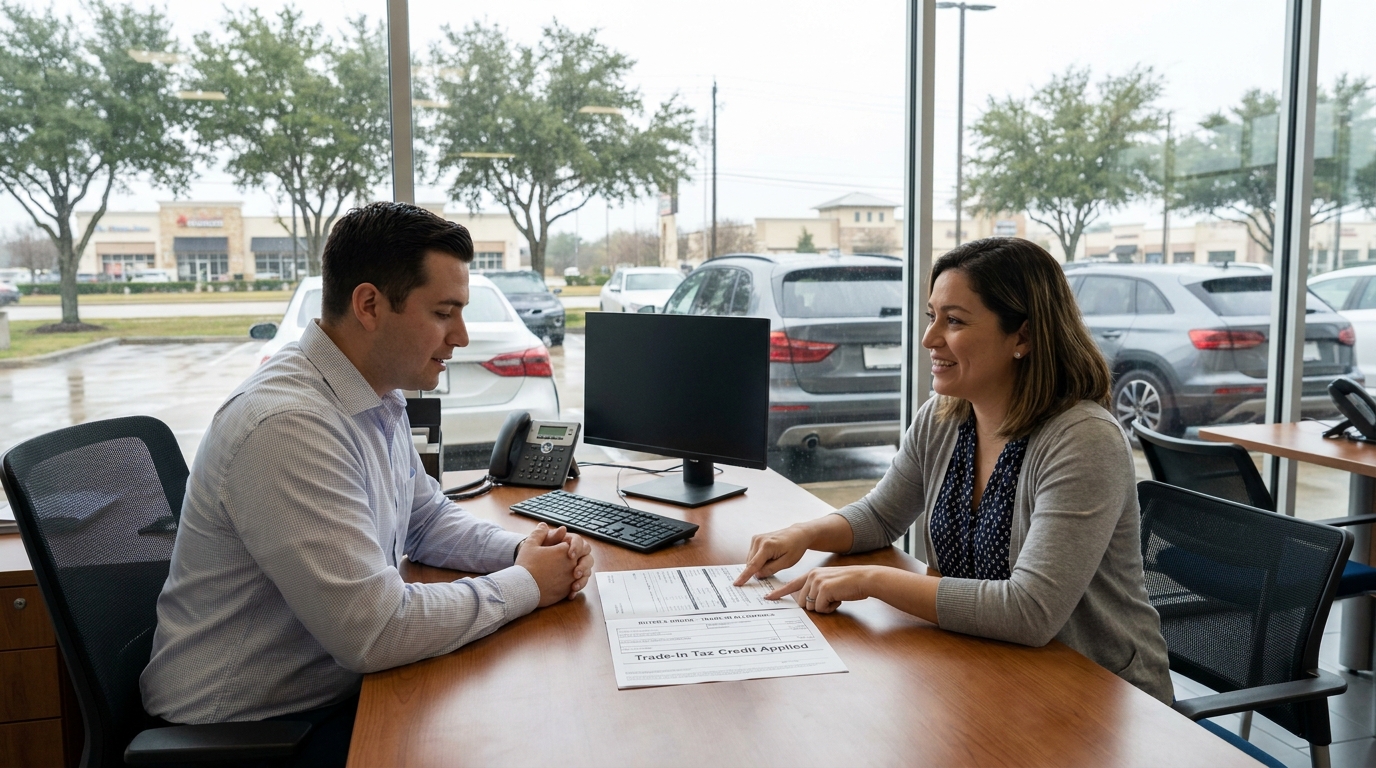
In Texas, trading in your current vehicle at a licensed dealer reduces the amount of sales tax you owe on your new car. The state's 6.25% motor vehicle sales tax is calculated on the sales price minus the agreed trade-in allowance — but only when both the trade-in and the purchase happen in the same transaction at the same licensed dealer, documented on the same invoice. Private-party sales and separate trade-ins don't qualify.
That distinction matters. Cypress, TX shoppers who understand it correctly often save hundreds — sometimes thousands — of dollars versus buyers who assume Texas works like California or another no-credit state. Below is how the rule actually functions, what qualifies, what doesn't, and how to make sure your buyer's order is written to capture the credit.
How does the Texas trade-in tax credit actually work in 2026?
Under Texas Tax Code Chapter 152, motor vehicle sales tax is 6.25% of the taxable sales price. When you trade a vehicle in at a licensed Texas dealer as part of the same purchase, the trade-in allowance is subtracted from the sales price before tax is calculated. You pay 6.25% only on the difference — not on the full sticker price of the new vehicle.
Here's the math in practice. If you buy a 2026 Volkswagen Atlas — starting at $39,310 MSRP as of November 2026, per Volkswagen — and trade in a vehicle the dealer values at $18,000, the taxable amount is $21,310. Your Texas motor vehicle sales tax is 6.25% of $21,310 — roughly $1,332 — not 6.25% of the full purchase price. The trade-in credit produces meaningful savings at the tax line alone.
This is a meaningful advantage compared to states that do not allow the offset. It also means the number written on the trade line of your buyer's order directly moves your tax bill. Every $1,000 of additional trade allowance the dealer gives you is worth roughly $62.50 in tax savings on top of the credit itself.
What qualifies as a trade-in under Texas law?
Only a motor vehicle qualifies as trade-in property under Chapter 152. The trade-in and the replacement vehicle must be part of the same transaction with the same licensed Texas motor vehicle dealer, and the trade allowance must be clearly stated on the sales invoice or buyer's order that documents the purchase. Anything else — cash, rebates, discounts, non-vehicle property — does not reduce the taxable base.
A few practical implications for Cypress, TX buyers:
- Manufacturer rebates and dealer discounts do not reduce your tax. If Volkswagen is offering an incentive on a 2026 Tiguan — starting at $30,805 MSRP as of November 2026, per Volkswagen — your taxable sales price is still calculated before that incentive is applied.
- Selling your old car to a neighbor first, then buying from a dealer, forfeits the credit. The trade must occur inside the dealer transaction and appear on the same paperwork.
- Non-vehicle trades don't count. A boat, trailer, or personal property offered against the purchase price won't move the taxable amount for motor vehicle sales tax purposes. According to the Texas Comptroller's guidance, only motor vehicles qualify — boats, airplanes, and livestock are specifically excluded.
- The trade allowance must be documented on the invoice — not agreed verbally and adjusted after the fact.
It's also worth noting that the trade-in value used to reduce the taxable amount is the full value of the vehicle traded in — not the owner's equity after any outstanding loan balance is paid off. If your trade is worth $20,000 but you still owe $12,000 on it, the full $20,000 reduces the taxable base, not just the $8,000 in equity.
What about private-party purchases in Cypress, TX?
Private-party used vehicle purchases in Texas do not qualify for a trade-in credit. Instead, tax is assessed on the greater of the stated sale price or the Standard Presumptive Value (SPV) determined by the Texas Comptroller. There is no mechanism to offset that tax by selling or trading another vehicle separately.
This is where a lot of Harris County buyers get surprised at the tax office. If you find a used pickup on a classified site, negotiate a low price, and try to reduce your tax by handing over your old sedan on the side, none of that changes what you owe. The state uses SPV as a floor to prevent under-reported sale prices.
The practical takeaway for Cypress, TX shoppers: if your current vehicle has real trade value and you're considering both a dealer purchase and a private-party purchase, the tax math frequently tips the decision toward the dealer route. The trade-in credit is only available inside a licensed dealer transaction like the ones handled at Volkswagen Cypress.
How does the credit work if you buy out of state and bring the car to Texas?
Vehicles purchased outside Texas and brought into Texas may be subject to Texas motor vehicle use tax, but the specific rules for out-of-state purchases and any credits for tax paid to another state are beyond the scope of this guide. The trade-in credit is not the primary offset mechanism for out-of-state purchases.
The rules governing how Texas treats tax paid to another state on an out-of-state vehicle purchase are not addressed here; consult the Texas Comptroller of Public Accounts or a qualified tax professional for guidance on your specific situation. Structuring a Louisiana trade to try to capture a Texas-style trade-in credit doesn't work the way in-state buyers might assume.
Where does the credit show up on your paperwork?
The trade-in allowance must be clearly stated on the sales invoice or buyer's order and linked to the purchase of the replacement vehicle. Dealers are required to accurately report the sales price, the trade-in value, the taxable amount, and the tax due. Trade-in information is documented on Form 130-U (Application for Texas Title and/or Registration), filed with the Texas Department of Motor Vehicles; for multiple trade-ins, the seller must describe the first trade-in in Box 36 and note additional trade-ins in Box 37.
Before you sign, read these lines on the buyer's order:
- Sales price of the new vehicle — this is the negotiated price before tax.
- Trade-in allowance — the agreed value assigned to your trade. This must be a motor vehicle, on the same document.
- Taxable amount — sales price minus trade-in allowance. This is what the 6.25% is applied to.
- Motor vehicle sales tax — 6.25% of the taxable amount.
If those lines don't add up, ask the finance office to walk through them. Misclassifying a rebate as a trade allowance, or splitting the transaction across two invoices, can trigger additional tax assessments, interest, and penalties during a Comptroller audit of the dealer — and the tax office will collect the correct amount at registration regardless of what the buyer's order said.
How to maximize the value of your trade at a Cypress, TX dealer
Because every additional dollar of trade allowance also reduces your taxable base, getting an honest, competitive number on your trade is worth more in Texas than it is in states without the credit. A few steps help:
- Get a written appraisal before you negotiate the new-car price. Separating the two conversations makes it easier to see the real trade number.
- Know your vehicle's independent valuation. Standard trade-in guides give you a range; the dealer's offer should fall inside a defensible band.
- Ask what the dealer would pay for your car outright, without a purchase attached. Some dealers, including Volkswagen Cypress, buy vehicles even when the customer isn't buying — but if you're also purchasing, keeping the trade inside the transaction is what unlocks the tax credit.
- Bring maintenance records. Documented service history typically supports a stronger appraisal, particularly on higher-mileage vehicles.
That matters at the trade line, where a rushed process is exactly where buyers lose money.
Frequently asked questions
Does Texas charge sales tax on the full price of a new car, or on the price after trade-in?
Texas charges 6.25% motor vehicle sales tax on the sales price minus the trade-in allowance, provided the trade-in and purchase occur in the same transaction at the same licensed Texas dealer and are documented on the same invoice. If there is no qualifying trade-in, tax is calculated on the full sales price.
Do manufacturer rebates reduce the taxable amount in Texas?
No. Under Texas Tax Code Chapter 152, only motor vehicles qualify as trade-in property. Manufacturer rebates, cash incentives, and dealer discounts do not reduce the taxable base for motor vehicle sales tax, even when they lower the amount the buyer actually pays. Tax is still calculated on the pre-rebate sales price minus any qualifying trade-in allowance.
What if my trade-in is worth more than the car I'm buying?
If the trade-in allowance equals or exceeds the purchase price of the replacement vehicle, no Texas motor vehicle sales tax is due because the taxable amount is zero or negative. According to the Texas Comptroller's guidance, no motor vehicle tax is owed in a trade-down scenario. The credit cannot generate a refund of tax on a separate transaction, but it fully zeroes out tax on the qualifying purchase itself.
Can I sell my old car privately and still get the trade-in tax credit on my next purchase?
No. The trade-in credit under Texas law applies only when the trade-in vehicle and replacement vehicle purchase occur with the same licensed dealer in the same transaction. Selling a vehicle separately — to a neighbor, an online buyer, or a different dealer — does not generate a credit against sales tax on a subsequent vehicle purchase.
How is tax calculated on a private-party used car purchase in Texas?
For private-party used vehicle purchases, Texas assesses 6.25% tax on the greater of the stated sale price or the Standard Presumptive Value (SPV) determined by the Texas Comptroller. No trade-in deduction is available on private-party transactions, and the SPV floor prevents under-reported sale prices from lowering the tax owed.
I bought a car in another state — do I still owe Texas tax?
Possibly. Texas may impose motor vehicle use tax on vehicles purchased outside Texas and brought into the state, but the specific rules for out-of-state purchases — including any credit for tax paid to another state — are beyond the scope of this guide. Consult the Texas Comptroller of Public Accounts or a qualified tax professional for guidance on your specific situation.
Does it matter if my trade-in vehicle still has a loan on it?
No — at least not for calculating the tax reduction. Under Texas law, the full value of the traded vehicle reduces the taxable amount, not just your equity after the loan payoff. So if your trade is valued at $20,000 and you owe $14,000 on it, the entire $20,000 still offsets the purchase price for tax purposes. The dealer handles the lien payoff separately.
Can a leased vehicle be used as a trade-in in Texas?
No. A lessee cannot trade in a leased vehicle because they are not the title owner. Only the titled owner of a motor vehicle can use it as a qualifying trade-in to reduce the taxable amount on a Texas vehicle purchase. If you are at the end of a lease, speak with Volkswagen Cypress about your options before structuring the transaction.
The bottom line for Cypress, TX buyers
The Texas trade-in tax credit is one of the more buyer-friendly rules in the country, but it only works if the transaction is structured correctly: same dealer, same day, same invoice, with the trade-in allowance stated clearly. Get that right and your 6.25% motor vehicle sales tax is calculated only on the difference between the new car's price and your trade — not the full sticker.
Cypress, TX shoppers who want the trade appraisal and the tax math walked through in plain language can contact Volkswagen Cypress at https://www.vwcypress.com or call (281) 532-8824 to schedule a trade appraisal or start a purchase. Sales hours are Monday through Saturday, 9:00 AM to 9:00 PM. For questions about your specific situation — particularly out-of-state purchases, gifts, or unusual title histories — the Texas Comptroller of Public Accounts is the authoritative source, and a qualified tax professional can advise on individual transactions.