SUVs vs. Trucks: Which Makes More Sense for Katy, TX Commuters?
SUV or truck for your Katy, TX commute? A practical 2026 buyer's guide covering I-10 traffic, fuel costs, family needs, and which vehicle type fits best.
If you commute from Katy into Houston, you already know the drill. The Katy Freeway (I-10) between the Grand Parkway and the Sam Houston Tollway routinely runs 25+ miles of stop-and-go during rush hour. Add in Cinco Ranch soccer practice, a Costco run off Fry Road, and a summer trip to Galveston, and the question gets real: SUV or truck?
Both work. But for most Katy commuters in 2026, one clearly makes more sense than the other. Here's how to decide.
The Katy Commute Reality Check
Katy isn't a small town anymore. Cinco Ranch, Firethorne, Cross Creek Ranch, and the newer developments along the Grand Parkway have pushed the population well past 25,000 inside city limits — with far more in the greater Katy ISD footprint. Most working adults here drive into the Energy Corridor, the Galleria, Downtown, or the Texas Medical Center.
That means:
- Long daily highway miles (often 40–70 miles round trip)
- Heavy stop-and-go during peak hours
- Flash-flood risk on feeder roads during Gulf storm season
- Blazing summer heat from May through September
- Frequent family and cargo duty on weekends
Your vehicle needs to handle all of it — not just look good in the driveway.
SUVs: Why They Win for Most Katy Commuters
1. Fuel Economy on I-10
Midsize and compact SUVs generally return significantly better mpg than full-size trucks. On a 60-mile daily commute, the difference between 27 mpg and 18 mpg adds up fast — often $80–$150 more per month at the pump, depending on gas prices.
2. Easier Parking Everywhere You Actually Go
LaCenterra at Cinco Ranch. Katy Mills. The garages downtown. Medical Center parking. Full-size trucks are 19+ feet long and don't fit cleanly in standard spaces. A three-row SUV like the Volkswagen Atlas is easier to park while still seating seven.
3. Family + Weather Coverage
Katy families haul kids, gear, dogs, and groceries — often all at once. An enclosed SUV cargo area keeps everything dry when a summer thunderstorm rolls through, which happens without warning here. An open truck bed doesn't.
4. Ride Comfort Over 25 Miles of Traffic
SUVs are built on car-based or crossover platforms tuned for smooth highway ride. Trucks — especially half-ton and larger — ride firmer because they're engineered to carry payload. On a daily I-10 grind, that difference matters by month six.
5. Lower Total Cost of Ownership
SUVs generally cost less to insure, less to fuel, and less to maintain than full-size trucks. If your commute is the primary use case, that math favors the SUV almost every time.
Trucks: When They're the Right Call
Trucks aren't wrong for Katy. They're right for specific buyers.
You Should Consider a Truck If:
- You tow a boat to Lake Houston, Somerville, or the coast more than a few times a year
- You work in construction, oil and gas services, ranching, or trades where a bed is a daily tool
- You haul lumber, mulch, or equipment regularly for a property in Fulshear, Brookshire, or the rural stretches west of Katy
- You need serious towing capacity (7,000+ lbs) that most SUVs can't match
- You genuinely use 4x4 off-pavement, not just for the look
If none of that describes your weekly life, you're likely paying a truck premium for capability you'll rarely use.
Head-to-Head: What Actually Matters for Katy Drivers
Fuel Costs
Winner: SUV. A compact or midsize SUV averaging 26–30 mpg highway will save meaningful money over a full-size truck averaging 17–20 mpg — especially on a long Katy-to-Energy-Corridor commute.
Cargo Flexibility
Winner: Depends. SUVs win for enclosed, weather-protected cargo and family gear. Trucks win for oversized, dirty, or bulky loads that don't fit indoors.
Weather Handling
Winner: SUV. Katy's heavy rainfall, occasional street flooding on roads like Mason and Fry after storms, and hot summers favor an enclosed cabin with strong AC and covered cargo. Both vehicle types handle standing water similarly when driven sensibly — but your groceries stay dry in an SUV.
Seating
Winner: SUV. Three-row SUVs comfortably seat 6–7. Crew-cab trucks seat 5 comfortably but sacrifice bed length to do it.
Resale in the Houston Market
Winner: Roughly a tie. Both trucks and SUVs hold value well in the greater Houston area — this is truck-and-SUV country. Specific models matter more than category.
Daily Drivability
Winner: SUV. Tighter turning radius, easier parking, better visibility around Katy's dense retail centers and school zones.
The Honest Middle Ground: What About Mid-Size Trucks?
If you like the truck aesthetic but commute daily, a mid-size truck splits the difference — better fuel economy than a full-size, still has a bed, easier to park. It's a legitimate compromise for buyers who occasionally haul but mostly commute.
Still, for pure commuter duty with family needs mixed in, a well-optioned SUV usually wins on comfort and running costs.
How to Decide: A Simple Framework
- Count your truck-required days per year. How many times in the last 12 months did you genuinely need a bed or 7,000+ lbs of towing? If it's under 20, an SUV covers you — and you can rent a truck the few times you need one.
- Calculate your real fuel cost. Multiply your daily commute miles by 250 workdays, then divide by the mpg of each option. The dollar gap is often bigger than buyers expect.
- Think about your passengers. Are you regularly hauling three or more people? Three-row SUV. Are you mostly solo or with one passenger? Either works.
- Factor in your parking reality. If you park downtown, in the Medical Center, or in a tight garage, size matters daily.
- Test drive both back-to-back. An hour behind the wheel of each — ideally on I-10 during a moderate traffic window — tells you more than any spec sheet.
Frequently Asked Questions
Are SUVs better than trucks for Houston-area flooding?
Neither is a boat. Ground clearance matters more than body style — and both trucks and body-on-frame SUVs typically sit higher than sedans. The real answer: don't drive through standing water, period. Turn around, don't drown.
What's the best SUV for a long Katy commute?
Look for something with strong highway mpg, comfortable seats, and modern driver-assist tech (adaptive cruise control is a lifesaver on I-10). Volkswagen's Tiguan and Atlas lineups are worth a look for commuters who want German road manners without a luxury-brand price.
Do trucks hold value better than SUVs in Texas?
In the Houston market, both categories hold value strongly. Specific model, mileage, condition, and trim matter more than the SUV-vs-truck category itself.
Where can I compare SUVs for sale near me in Katy?
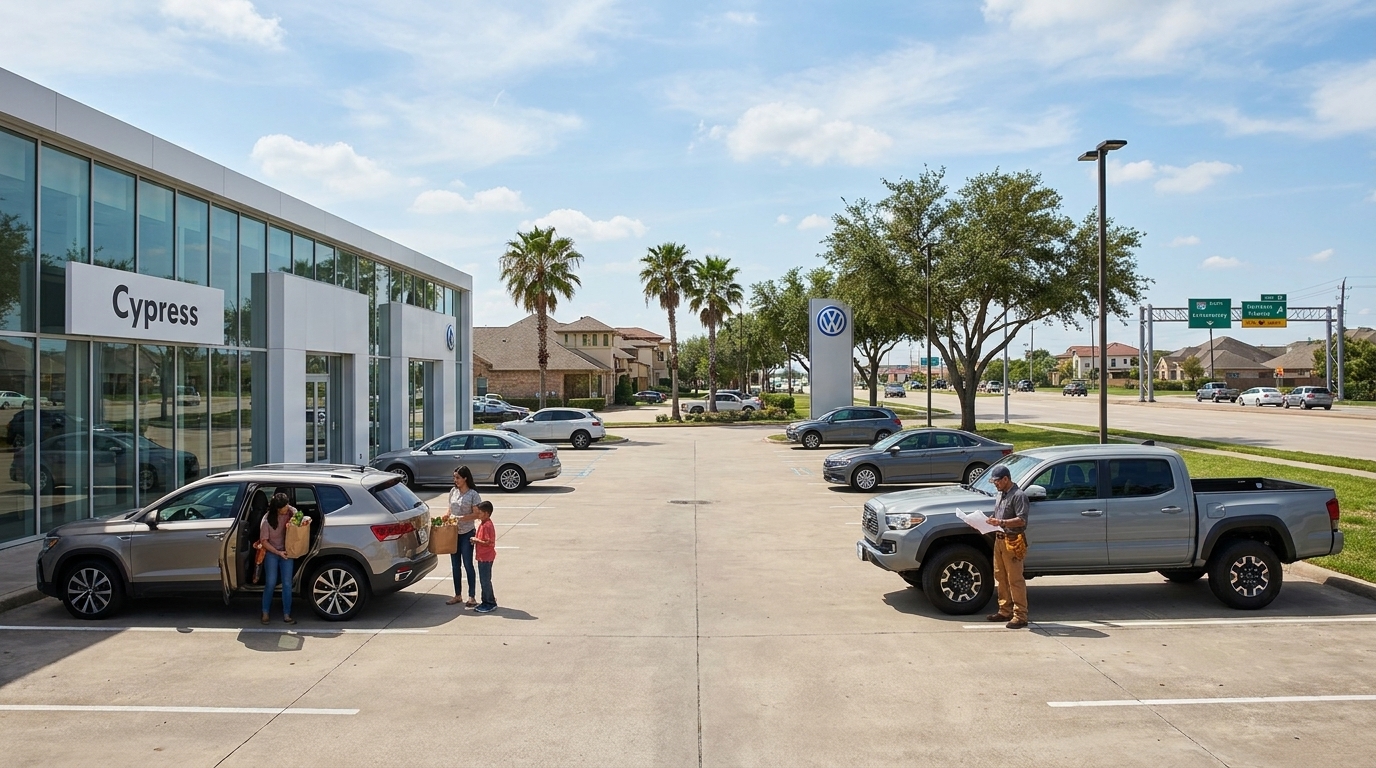
Local dealerships along the I-10 corridor, including new car dealers just east of Katy in the Cypress area, carry strong SUV inventory. Volkswagen Cypress is one option worth visiting if you're weighing three-row family SUVs or efficient commuter crossovers.
The Bottom Line for Katy Commuters
For the majority of Katy drivers — the ones logging long I-10 miles, hauling kids and gear, and rarely needing a truck bed — an SUV is the more practical choice in 2026. Better fuel economy, easier parking, more comfortable ride, enclosed cargo, and stronger match to how families here actually live.
Trucks earn their spot when the work demands it: towing, trades, land, or genuine off-road use. If that's you, buy the truck and don't apologize for it.
If you want to compare specific models side by side without a pushy sales floor, the team at Volkswagen Cypress on the northwest side of Houston works with Katy commuters regularly and carries a range of SUVs suited to long-highway life. Their 4.4★ Google rating across more than 3,700 reviews reflects a no-pressure approach — one reviewer described the experience as "smooth and stress-free." You can browse inventory or schedule a test drive at https://www.vwcypress.com.