How to Maximize Trade-In Value at Houston Dealership
Learn how to prep, time, and negotiate your Houston trade-in for the highest offer. Practical steps, paperwork, and pricing tactics for 2026 sellers.

To get the most money for your trade-in at a Houston dealership, arrive with a clean, mechanically sound vehicle, three written offers from competing appraisers, complete service records, and a firm walk-away number. Negotiate the trade-in as a separate transaction from the new-car price, and time your visit before Gulf humidity, hail season, or a model refresh drags your value down.
Houston's trade-in market moves fast. Inventory swings, hurricane-season damage claims, and the sheer size of the Katy-Cypress-Houston metro mean two dealerships can quote wildly different numbers on the same car in the same week. Your job is to shrink that gap in your favor.
What should you do to prepare your car for a Houston trade-in?
Detail the vehicle inside and out, fix cheap cosmetic issues (bulbs, wiper blades, scuffed trim), gather every service record, and clear personal items and Bluetooth pairings. A well-presented car in Houston typically appraises several hundred to a few thousand dollars higher than the same car showing neglect, because appraisers price in reconditioning costs.
Start with a professional detail — expect to pay $150-$250 in the Houston metro for a full interior/exterior package. That investment routinely returns multiples of itself. Pay special attention to:
- Sun-faded dashboards and cracked leather, common on Houston vehicles from the Beltway 8 commute and summer surface temperatures that regularly exceed 140°F.
- Water spots and mineral deposits from hard tap water.
- Sand and salt residue if you drive to Galveston.
- Pollen buildup in cabin filters, especially after February-through-April oak pollen season.
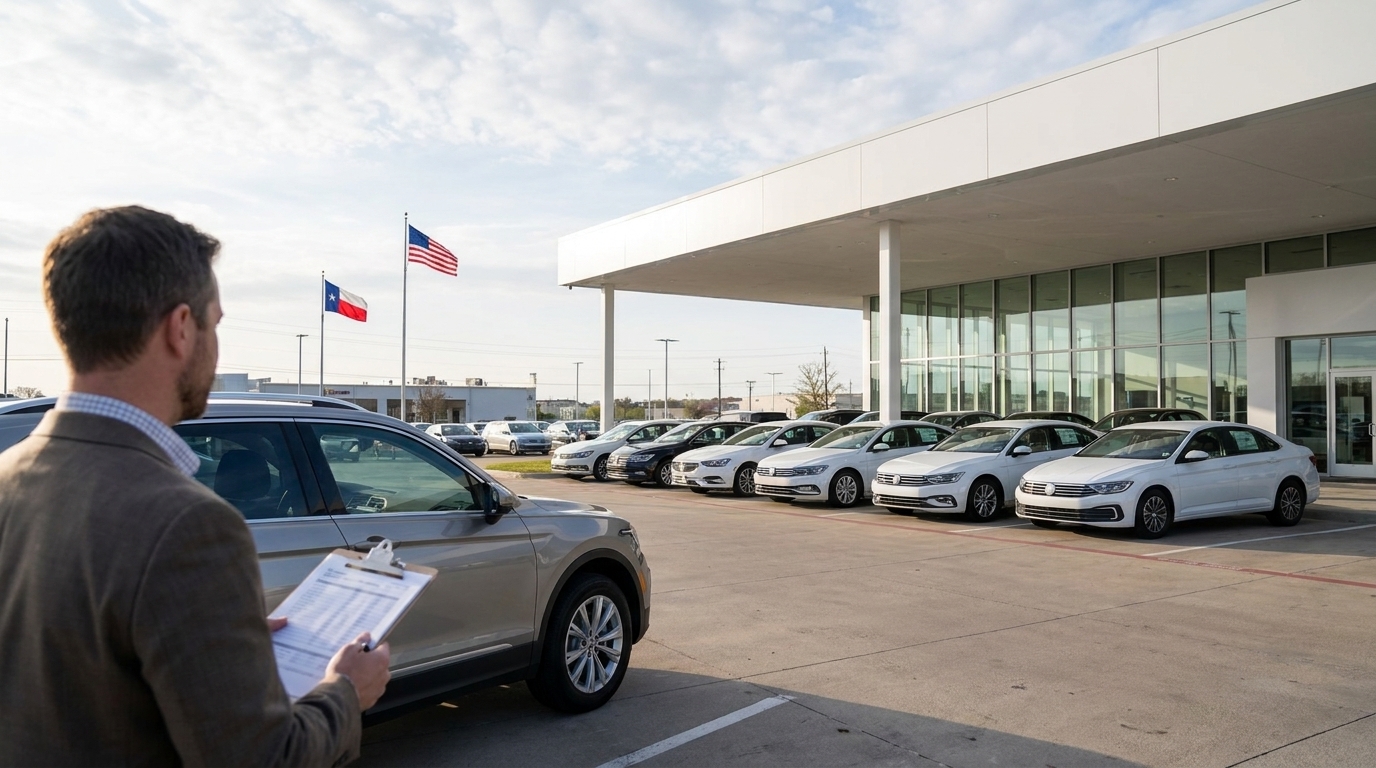
Fix small mechanical annoyances — a burned-out license plate light or a dead key fob battery signals deferred maintenance to an appraiser. At dealerships like Volkswagen Cypress, appraisers walk the vehicle with a checklist, and every flagged item becomes a deduction line.
How do you research your trade-in value before visiting a Houston dealership?
Pull written valuations from at least three sources — Kelley Blue Book, Edmunds, and a dealer's instant-cash-offer tool — using your exact VIN, mileage, trim, and options. Also get a written offer from CarMax or a comparable cash-offer service, which is valid for seven days in Texas and gives you a hard floor to negotiate against.
Use the trade-in value (not private-party) as your dealer benchmark, because that's the number a dealership is actually competing against. Then check active listings on AutoTrader and Cars.com for your same year, trim, and mileage within a 50-mile radius of Houston. If comparable vehicles are sitting on lots for 60+ days, expect softer offers; if they're moving in under 30 days, push harder.
Bring printouts. Verbal claims about "what KBB says" carry no weight; a printed valuation with your VIN on it does.
When is the best time to trade in a car in Houston?
The strongest trade-in windows in Houston fall at month-end and quarter-end when sales staff chase volume bonuses, and in late winter through early spring before hurricane season (June 1 through November 30) introduces flood-title risk that softens the whole used market. Avoid trading in immediately after a new model year release for your vehicle, which mechanically drops your value.
Specific timing tactics that work in the Houston market:
- Last three days of the month: Managers approve stronger appraisals to close deals against quota.
- February through April: Tax-refund buyers flood the used market, lifting wholesale demand.
- Before hail season: Spring hailstorms across Harris and Fort Bend counties can total a car overnight — trading before a storm is far better than after.
- Avoid August: Extreme heat exposes AC weakness on test drives, and back-to-school inventory shifts favor buyers, not sellers.
How should you negotiate the trade-in at a Houston dealership?
Negotiate the trade-in and the new-vehicle price as two completely separate transactions. Agree on the new car's out-the-door price first, then introduce the trade-in. Present your written competing offers, name a target number slightly above your highest outside quote, and be willing to walk away — the willingness to leave is what moves the appraisal.
A few Houston-specific negotiation points worth knowing:
- Texas trade-in tax credit: Texas taxes the difference between the new vehicle's price and your trade-in allowance at 6.25% state motor vehicle sales tax. On a $40,000 new car with a $15,000 trade-in, you pay tax on $25,000 — saving roughly $937 versus selling privately. Factor that into whether a private-party offer actually beats the dealer offer.
- Ask for the appraisal breakdown. Reputable Houston stores will walk you through reconditioning deductions line by line. If they won't, that's information about the dealership.
- Don't disclose your payoff first. The appraisal should reflect the car's value, not your loan balance.
Volkswagen Cypress, which holds a 4.4-star average across more than 3,700 Google reviews, is regularly cited by customers for a no-pressure approach — one recent reviewer described the process as "smooth and stress-free." That matters at the trade-in desk, because pressure tactics are where sellers typically lose money.
What paperwork should you bring to a Houston trade-in appointment?
Bring the title (or lienholder contact and current payoff amount), current registration, both sets of keys and any key fobs, the owner's manual, all service records, and a valid Texas driver's license. Missing any of these items gives the appraiser a reason to shave your offer or delay closing.
Checklist
- Title, or 10-day payoff quote from your lender
- Current Texas registration and proof of insurance
- All keys, fobs, wheel locks, and cargo covers
- Owner's manual and any window sticker or build sheet
- Service records, especially timing belt, transmission service, and recent tires
- Aftermarket receipts (only if the mod adds mainstream value — tint, tow package)
How do preparation choices affect your final offer?
Small, cheap preparation steps typically produce the largest percentage gains, while expensive mechanical repairs rarely pay back. The table below shows typical impact ranges Houston sellers see on a mid-market trade-in valued around $20,000.
| Preparation Step | Typical Cost | Typical Offer Impact |
|---|---|---|
| Full professional detail | $150-$250 | +$400 to +$1,200 |
| Repair minor cosmetic items (bulbs, wipers, trim) | $50-$150 | +$200 to +$500 |
| Provide complete service records | $0 | +$300 to +$800 |
| Fix major mechanical issue (transmission, engine) | $2,000+ | Rarely recovers cost — disclose instead |
| New tires (if under 3/32" tread) | $600-$1,000 | +$400 to +$700 |
| Paintless dent repair for hail dings | $100-$500 per panel | +$500 to +$2,000 (varies) |
| Bring three written competing offers | $0 | +$500 to +$2,500 |
Frequently asked questions about Houston trade-ins
Does Texas give a sales tax credit for a trade-in?
Yes. Texas applies the 6.25% state motor vehicle sales tax to the difference between the new vehicle's sale price and the trade-in allowance, not the full purchase price. This credit only applies when trading in at a licensed dealer — private-party sales do not qualify. On larger transactions the tax savings can meaningfully close the gap between a dealer offer and a private-party offer.
Should I fix mechanical problems before trading in?
Usually no. Major repairs like transmission work, timing chains, or head gaskets rarely return their cost in a higher appraisal, because dealerships perform reconditioning at wholesale rates you can't match. Disclose the issue instead and let the appraiser price it. Small, cheap fixes — bulbs, wipers, a dead battery, a missing cargo cover — are the exception and consistently pay back.
Is it better to sell privately or trade in at a Houston dealership?
Private-party sales typically net $1,500-$3,500 more on paper, but the Texas trade-in tax credit, the time investment, and the risk of dealing with strangers often close the gap. If your car is worth under $10,000 or has cosmetic damage, trading in usually wins. For clean, sought-after vehicles above $20,000, running the math on both paths is worth it.
How does Houston's climate affect my trade-in value?
Sun exposure, humidity, and hail all reduce Houston-area trade-in values relative to the national average. Faded paint, cracked dashboards, corroded battery terminals from humidity, and hail dings are the most common deductions. Garaged vehicles and cars with quality window tint typically appraise several hundred dollars higher than daily-parked-outside counterparts in the same model and mileage.
Can I trade in a car that still has a loan?
Yes. The dealership pays off your lender directly using a 10-day payoff quote and applies any remaining equity to your new purchase. Call your lender before your appointment and request the payoff figure in writing. If you owe more than the car is worth, that's a negative-equity situation with its own considerations — ask the dealer to break out the numbers clearly.
How long does the trade-in process take at a Houston dealership?
Plan on 30-60 minutes for the appraisal itself and another 60-90 minutes for paperwork if you're also purchasing a new vehicle. Bringing your title, payoff information, keys, and service records up front is the single biggest time-saver. Scheduling a morning weekday appointment typically moves faster than a Saturday afternoon walk-in.
Getting professional help in Houston
Maximizing a trade-in offer comes down to preparation, timing, documentation, and negotiating the trade separately from the new-car price. Houston sellers who show up with a detailed car, three written offers, complete records, and a walk-away number consistently leave with more money than those who don't.
Readers in the Houston area who want a straightforward appraisal and a transparent trade-in conversation can reach Volkswagen Cypress at https://www.vwcypress.com to schedule an appointment or request an initial offer online.