Electric vs Hybrid vs Gas: Which Vehicle Type is Right for You in 2026
Compare electric, hybrid, and gas vehicles on cost, fuel efficiency, range, and emissions to find the right fit for Cypress drivers in 2026.
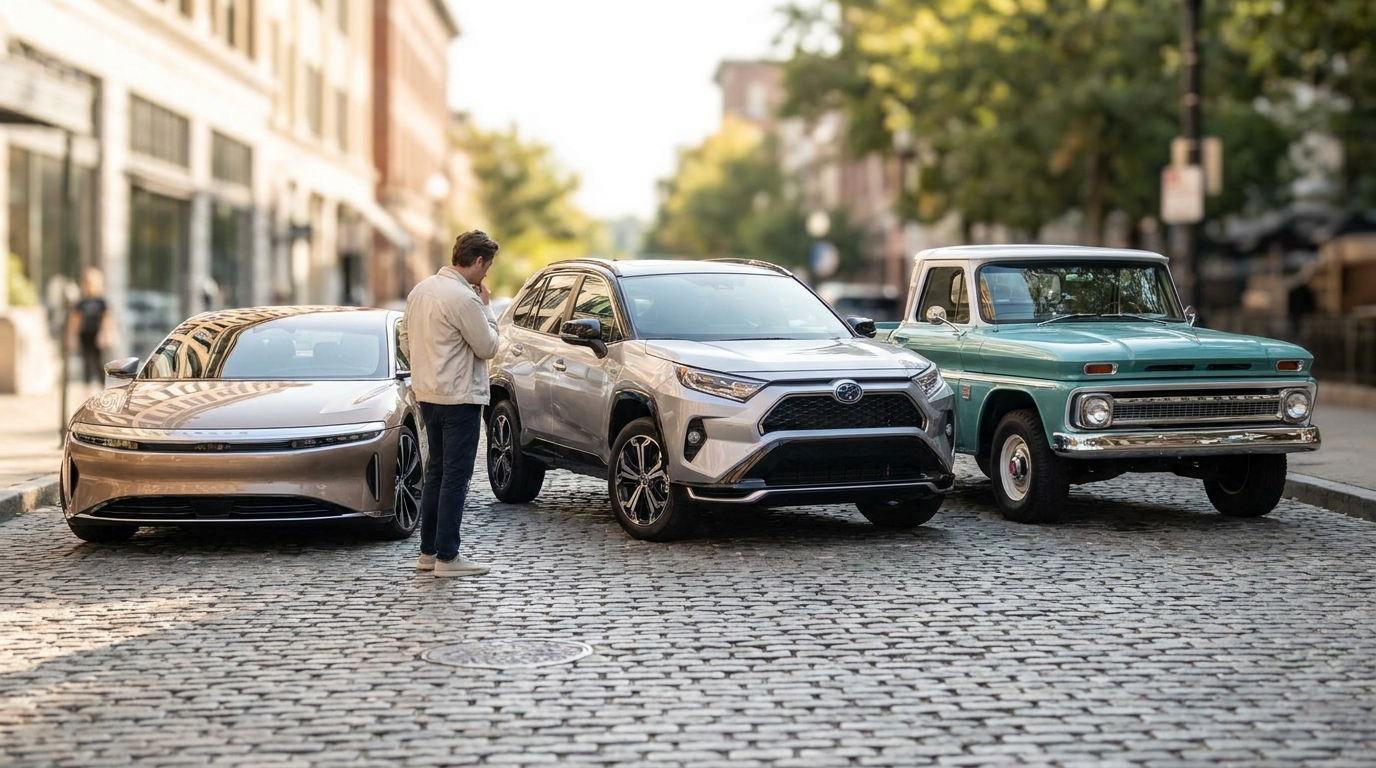
If you're shopping for a new vehicle in Cypress this year, you're walking into the most diverse showroom era in automotive history. Electric, hybrid, and gas-powered options each make a strong case — and the right answer depends less on which technology is "winning" and more on how you actually drive, where you park, and what you can charge at home.
This guide breaks down how the three powertrains compare in 2026, with the kind of detail you'd want from someone who sells all of them. We'll cover upfront cost, fuel efficiency, range, emissions, maintenance, and ownership cost, then close with a practical buyer profile so you can match the technology to your life.
The Quick Answer: Electric vs Hybrid vs Gas Cars
Electric vehicles deliver the lowest running costs, zero tailpipe emissions, and instant torque, but they carry the highest sticker price and depend on charging infrastructure. Hybrids bridge the two worlds — pairing a gas engine with electric assist for strong fuel economy, with no plugs or range anxiety. Gas vehicles remain the most affordable upfront, refuel in five minutes at any station across the country, and still lead in towing.
For most Cypress buyers in 2026, hybrids hit the sweet spot. EVs make outstanding sense for predictable commuters with home charging. Gas vehicles still win for high-mileage drivers, towing duty, and longer trips out toward Hempstead or Brenham where charging stops are sparser.
Upfront Purchase Price
Gas vehicles open the price ladder. Starting MSRPs in this segment generally run from the mid-$20,000s — a Toyota Corolla LE gas trim sits near the floor of that range. Hybrids cost a modest premium, starting in the upper-$20,000s to low-$30,000s, according to manufacturer specifications.
EVs start higher, with mainstream models typically beginning in the low-to-mid $30,000s before incentives. Federal and state incentives — including programs such as New York's NYSERDA rebate and federal tax credits — can pull effective EV pricing down meaningfully, though eligibility depends on income limits, MSRP caps, and final assembly location. Verify your specific situation before counting on any incentive. MSRPs across all three categories exclude destination charges and dealer fees.
Fuel Efficiency: Where Hybrids and EVs Pull Ahead
This is where the gap gets wide. Gas vehicles carry the lowest fuel economy of the three powertrain types. Hybrids step up sharply, delivering significantly better mileage than gas — especially in city driving where regenerative braking captures energy that would otherwise be lost. EVs operate on a different scale entirely, rated in MPGe and carrying the lowest energy cost per mile of any powertrain type.
For Houston-area commuters dealing with stop-and-go traffic on 290 or the Grand Parkway, hybrids shine because regenerative braking actually rewards congestion. EVs benefit from the same physics, plus they sip electricity rather than gasoline.
Range and Refueling
Gas and hybrid vehicles both offer long per-tank range and refuel in about five minutes anywhere. That matters in greater Houston, where summer evacuation routes and long Gulf Coast road trips are part of life.
EVs require home or public charging; long trips require planning around charging stops. Charging time varies depending on the charger type and vehicle, from faster DC fast chargers at public stations to slower overnight Level 2 home setups. If you can install a 240V charger in your garage — common in Cypress neighborhoods like Bridgeland, Coles Crossing, and Fairfield — daily charging becomes a non-event. If you live in an apartment near the Houston Premium Outlets without dedicated parking, that calculus changes.
Emissions and the Texas Grid
EVs produce zero tailpipe emissions. Gas vehicles produce the highest tailpipe emissions of the three. Hybrids cut emissions compared to gas but are not zero-emission — plug-in hybrids (PHEVs) reduce them further by offering some electric-only driving range.
Worth noting for Texas drivers: an EV's overall carbon footprint depends on how the local grid generates electricity. ERCOT's generation mix has been shifting toward more wind and solar, so the environmental case for EVs in Texas continues to strengthen — though it's not as clean as a grid heavy in nuclear or hydro.
Maintenance Cost
EVs are the clear winner here. No oil changes, no spark plugs, no exhaust system, and regenerative braking dramatically extends brake-pad life. The main one-time expense is a home charger installation — a relevant consideration for older homes in parts of Cypress where panel upgrades may be needed.
Gas vehicles carry the highest routine maintenance costs of the three types. Hybrids generally come in lower than gas thanks to reduced engine wear and brake savings, though their dual powertrains can mean more complex repairs when something does go wrong.
Five-Year Ownership Cost
When you stack everything — purchase price, fuel, maintenance, and incentives — the picture changes. EVs offer the lowest energy cost per mile and the lowest maintenance burden, and with qualifying incentives their effective purchase price can approach hybrid territory. Hybrids occupy a strong middle position: lower fuel costs than gas with no infrastructure requirements. Gas vehicles carry the lowest purchase price but the highest ongoing fuel and maintenance expenses.
The EV total-cost advantage depends on qualifying for available incentives and having reliable home charging. Without those, gas and hybrid costs become more competitive on a five-year basis.
Performance and Driving Character
EVs deliver instant torque and the quickest off-the-line acceleration in their class. The ride is silent and smooth — a real perk in Houston traffic. Electric motors deliver peak torque immediately, making mainstream EVs typically the quickest from a standing start.
Gas vehicles still own towing and high-speed cruising. If you're hauling a boat down to Galveston or a trailer toward the Hill Country, a gas powertrain remains the proven choice. Hybrids split the difference: smooth gas-electric transitions, quiet EV-mode crawling in traffic, and instant torque assist when you need it.
Which Vehicle Type Is Right for You?
Choose an EV if:
- Your daily driving is predictable and within the vehicle's single-charge range
- You can install 240V home charging
- You qualify for federal and state incentives
- You value the lowest possible running costs and zero tailpipe emissions
Choose a Hybrid if:
- You want strong fuel economy without changing how you refuel
- You take occasional long trips and don't want to plan around chargers
- You want lower emissions than gas without EV infrastructure commitments
Choose a Gas Vehicle if:
- You drive high annual mileage in areas where charging is sparse
- You tow regularly or travel to remote areas
- You want the lowest upfront price and simplest ownership
Frequently Asked Questions
Are hybrids eligible for the federal tax credit?
Standard hybrids generally are not. Plug-in hybrids (PHEVs) may qualify depending on the model and your eligibility. EVs are the primary beneficiaries of federal and state incentive programs. Always verify current eligibility requirements directly with the IRS or your state's energy office before purchase.
How long does it take to charge an EV at home?
On a 240V Level 2 charger, most EVs charge overnight. DC fast charging at public stations can deliver substantial range in a fraction of that time, depending on the vehicle and charger output.
Do hybrids need to be plugged in?
Standard hybrids do not — they recharge their batteries through the gas engine and regenerative braking. Only plug-in hybrids and EVs require external charging. This makes traditional hybrids a straightforward upgrade for drivers not ready to change refueling habits.
Will an EV work for me if I live in an apartment in Cypress?
It depends on whether your building offers EV charging or whether reliable public charging exists on your daily route. Without home charging, a hybrid is usually the more practical pick.
What is a plug-in hybrid (PHEV) and how does it fit between a hybrid and a full EV?
A plug-in hybrid carries a larger battery than a standard hybrid and can run on electricity alone for a limited range before the gas engine takes over. PHEVs can be plugged in to charge but also refuel like a conventional car. They suit drivers who want some electric-only driving without full dependence on charging infrastructure — and may qualify for incentives that standard hybrids do not.
Does it matter which state I'm in when buying an EV?
Yes, meaningfully. State rebate programs — such as those administered by NYSERDA in New York — can reduce the effective purchase price well below the sticker price. Regional differences in electricity rates also affect the long-term fuel-cost advantage of EVs. Buyers should research their specific state's current programs before finalizing a purchase decision.
Finding the Right Fit in Cypress
The honest truth is that there's no universally correct answer — only the right answer for your driving patterns, budget, and home setup. The most useful step is sitting in all three powertrains, driving them back-to-back, and seeing which feels right for your life.
Volkswagen Cypress carries gas, hybrid, and EV options across the Volkswagen lineup, and the team is comfortable walking buyers through the tradeoffs without steering anyone toward a powertrain that doesn't fit. If you'd like to compare these vehicle types in person, you can reach the team at vwcypress.com to schedule test drives or talk through what makes sense for your situation.