Bad Credit Car Approval in Houston, TX: How It Works
How Houston dealership financing approval actually works for bad-credit buyers — the income, DTI, collateral, and down-payment math lenders use behind the scenes.

A bad credit score in Houston does not automatically disqualify a buyer from dealership financing. Lenders approve or decline based on a combination of verified income, debt-to-income ratio, the vehicle's value as collateral, and the size of the down payment — the credit score is one input, not the verdict. A low score typically translates to a higher rate, a larger required down payment, or a smaller approved loan amount rather than an outright no.
How does dealership financing approval actually work for bad credit in Houston?
A franchised Houston dealership takes the credit application and submits it to one or more third-party lenders — banks, credit unions, and the manufacturer's captive finance arm — who each run their own underwriting. Each lender weighs the credit score alongside income, DTI, loan-to-value on the vehicle, and down payment, then returns an approval, a conditional approval, or a decline. The dealership presents the best workable offer; the salesperson does not make the credit decision.
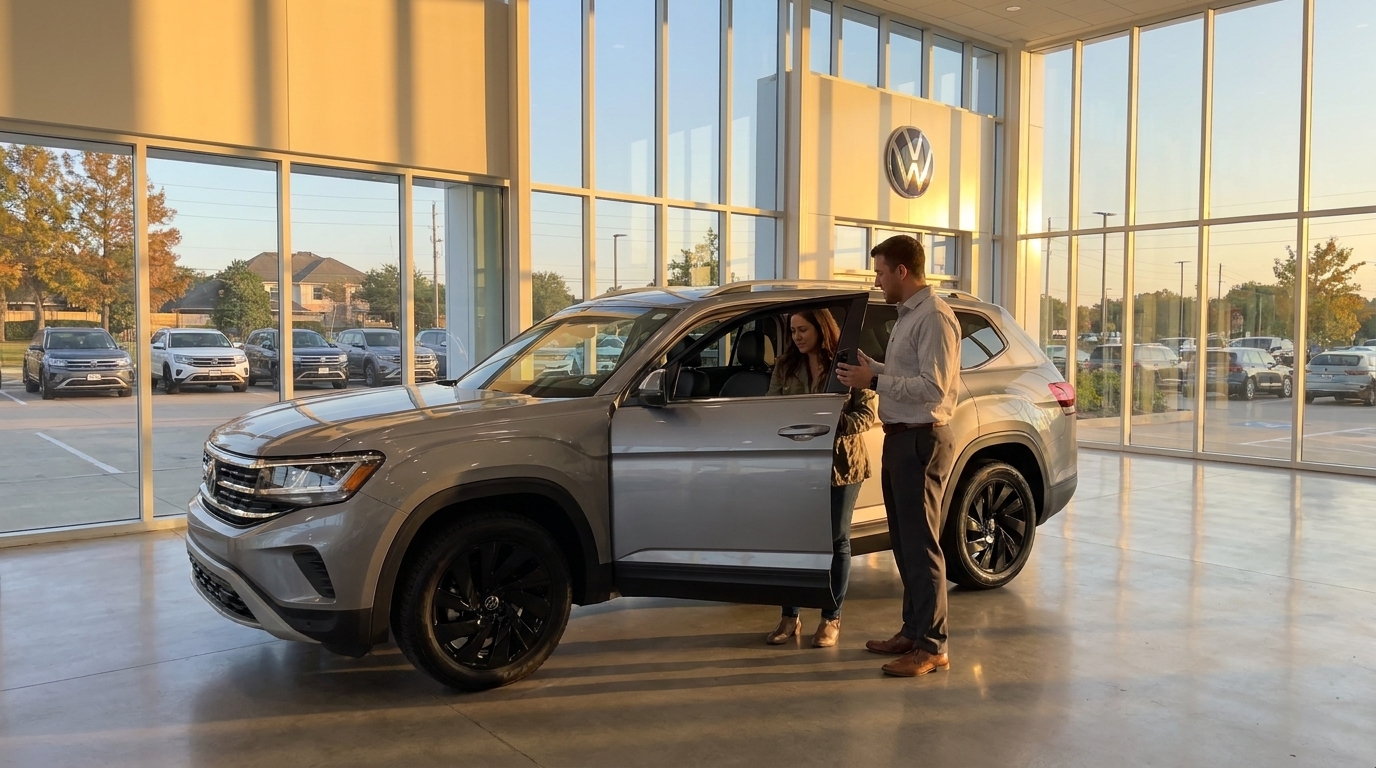
Volkswagen Cypress works with local and national lenders, as well as banks and lenders across Houston, which widens the pool of underwriters reviewing a single application. More reviewers increases the odds that at least one lender's model accepts the file, particularly for subprime and near-prime applicants whose numbers fall outside any single bank's box.
What credit score tier does a Houston buyer fall into?
Experian groups auto-loan applicants into five tiers: super-prime at 781 and above, prime 661–780, near-prime 601–660, subprime 501–600, and deep subprime 300–500. Houston buyers with scores in the lower two tiers are the ones who typically worry about approval, but both tiers routinely get financed — the cost is simply higher.
The pricing difference is substantial. In Q2 2026, Experian reported average APRs of 13.52% for new cars and 19.10% for used cars in the subprime band, and 16.11% for new cars and 21.62% for used cars in the deep-subprime band. These are national averages — individual offers vary by lender, vehicle, and term — but they show why the same car can cost two very different monthly payments depending on which tier the applicant lands in.
One other wrinkle: lenders may pull a FICO Auto Score rather than a general FICO score before issuing a car loan, and that number can differ from the score a buyer sees on a free credit app. The number on the dealership's screen is often the one that actually prices the loan.
How does debt-to-income ratio factor into approval?
Debt-to-income ratio — monthly debt payments divided by gross monthly income — is often the quiet reason a marginal file gets declined. Wells Fargo describes a DTI of 35% or less as the level at which lenders generally view the ratio as favorable, while a DTI of 50% or more can cause lenders to limit borrowing options. One federal regulation (12 CFR § 244.18) sets a 36% maximum DTI and requires income verification for a specific regulatory category of qualifying automobile loan; that is a category standard, not a universal cutoff every lender uses.
For a bad-credit applicant, DTI often determines the ceiling. Two buyers with identical credit scores can receive different outcomes: the one at a lower DTI gets approved on the vehicle they want, while the one at a higher DTI is pushed toward a cheaper car or asked for a co-applicant. Bringing recent pay stubs or bank statements to the dealership lets the finance office document income accurately rather than estimate downward.
Franchised dealer vs. buy-here-pay-here: what's the difference?
The two financing paths look similar from the curb but work very differently under the hood.
| Factor | Franchised dealership (third-party lenders) | Buy-here-pay-here (in-house financing) |
|---|---|---|
| Who approves the loan | Bank, credit union, or captive lender | The dealership itself |
| Credit check | Yes — hard inquiry | Often no credit check |
| Primary approval factor | Credit tier, income, DTI, LTV | Proof of steady income and down payment |
| Down payment | Varies by lender and tier | Typically larger — the lot's main protection against loss |
| Vehicle selection | New and used across the lender's eligible inventory | Limited to the lot's in-house financed stock |
A no-credit-check dealership — also called buy-here-pay-here — finances vehicles in-house without pulling the applicant's credit report, basing approval primarily on proof of steady income and the size of the down payment. The Texas Office of Consumer Credit Commissioner notes that independent dealers in Texas sometimes rely on current income or down-payment affordability instead of a traditional credit check, but cautions that the arrangement is not automatically inexpensive and not every lender actually skips the credit review.
What role does the down payment and vehicle choice play?
Down payment and vehicle price together control loan-to-value, which is the ratio lenders care about almost as much as the credit score. A smaller loan against a reasonably priced vehicle is a safer bet for the underwriter, and that math is often what flips a conditional approval into a clean one. For a no-down-payment car loan, most lenders want to see a credit score of 680 or higher; below that threshold, approval may still be possible but can require a higher interest rate, stricter terms, a co-signer, or a trade-in.
Choosing a less expensive vehicle is one of the most effective levers a subprime buyer has. the 2026 Volkswagen Jetta, starting at $23,995 (as of November 2026) sits well below the 2026 Volkswagen Atlas, starting at $39,310 (as of November 2026), and the smaller loan amount changes the LTV, the monthly payment, and the DTI calculation all at once. Volkswagen Cypress carries the full lineup of new Volkswagen models — the Atlas, Atlas Cross Sport, Golf GTI, Golf R, ID. Buzz, ID.4, Jetta, Jetta GLI, Taos, and Tiguan — which gives a subprime applicant room to move down in price without leaving the showroom.
What is spot delivery, and should Houston buyers be cautious of it?
Spot delivery is when a dealership lets a buyer take the vehicle home before final lender approval is locked in. It is legal and common, but it is also the moment where a deal can unravel — if the lender later declines the submitted terms, the buyer may be asked to return, re-sign at a higher rate, or add a co-signer. The Federal Trade Commission advises consumers to understand financing terms before signing and to be cautious when a dealer says the deal is not final.
The practical defense is straightforward: before driving off, confirm in writing whether the financing is fully approved or contingent, and read the clause that governs what happens if the loan falls through. In a market where summer heat, long highway commutes, and hurricane-season disruptions make being without a vehicle costly, understanding the delivery status upfront matters more than the convenience of leaving the same day.
How can a Houston buyer improve approval odds before applying?
Three moves do most of the work. First, bring documentation — recent pay stubs, two months of bank statements, proof of residence, and a driver's license — so the finance office can verify income rather than estimate it. Second, consider a larger down payment or a trade-in to lower the loan amount and improve LTV. Third, shop within a tight window: most credit scoring models treat multiple hard inquiries for an auto loan within 14 to 45 days as a single inquiry, so comparing lenders does not stack up credit damage.
A hard credit pull stays on the credit report for about two years, which is another reason to concentrate applications rather than spread them across months. A co-applicant with stronger credit can also change the outcome, particularly for buyers whose income is solid but whose score was damaged by a specific past event.
My Wife came in yesterday to finance a vehicle for her and myself, the process and customer service was professional and smooth.
Frequently asked questions
Can I get approved for a car loan in Houston with a 550 credit score?
Yes, approval at a low credit score is possible but usually priced in the subprime tier. Experian's Q2 2026 data shows average APRs of 13.52% for new cars and 19.10% for used cars in the 501–600 band. Approval will depend on verified income, debt-to-income ratio, the size of the down payment, and the price of the vehicle relative to the loan amount.
Does applying at multiple Houston dealerships hurt my credit?
Not meaningfully, if the applications happen close together. Most credit scoring models treat multiple hard inquiries for an auto loan within a 14 to 45 day window as a single inquiry. A hard pull stays on the credit report for about two years, but concentrating shopping into one short period keeps the score impact to roughly one inquiry's worth rather than several.
What income do I need to qualify for a car loan with bad credit?
There is no universal income floor, but debt-to-income ratio matters more than raw income. Wells Fargo considers a DTI of 35% or less favorable to lenders, while 50% or more may limit borrowing options. A bad-credit applicant with steady, documentable income and a manageable DTI is in a workable position; higher DTIs usually require a larger down payment or a cheaper vehicle.
Is in-house financing a good option for bad credit in Houston?
In-house or buy-here-pay-here financing can be a path for buyers who cannot get third-party approval, but it comes with tradeoffs. These dealers typically require larger down payments because the down payment is their main protection against loss, and vehicle selection is limited to the lot's financed inventory. The Texas Office of Consumer Credit Commissioner notes such arrangements are not automatically inexpensive.
What documents should I bring to a Houston dealership for bad-credit financing?
Bring a valid driver's license, recent pay stubs, two months of bank statements, proof of residence such as a utility bill, and proof of insurance. If using a trade-in, bring the title and payoff information. Documented income lets the finance office submit an accurate application rather than conservative estimates, which directly affects approval and rate.
Why does my credit score look different at the dealership than on my phone app?
Lenders may look at a FICO Auto Score before issuing a car loan rather than the base FICO score most consumer apps display. The score a lender sees may differ from the number a consumer app displays, and different credit bureaus may use different FICO versions for the same loan product. Different credit bureaus may also use different FICO versions for the same loan product, so the dealership's number is often the one that actually prices the loan.
The bottom line for Houston buyers
Dealership financing approval with bad credit is a math problem the lender solves using income, DTI, LTV, and down payment — with the credit score as one weight among several. Houston buyers who document income, shop within a tight window, and stay realistic about vehicle price give themselves the strongest hand. Volkswagen Cypress offers financing rates direct from the manufacturer and local Texas banks, and offers auto loans with terms up to 84 months, which gives the finance team room to structure a payment that fits an approved file. Readers in Houston who want to walk through the numbers on a specific vehicle can reach Volkswagen Cypress at (281) 532-8824 or https://www.vwcypress.com to get started.