Atlas vs Explorer Size Comparison in Cypress, TX
Compare 2026 VW Atlas vs Ford Explorer cargo, cabin, and third-row seating specs side by side to find the roomier three-row SUV for Cypress families.
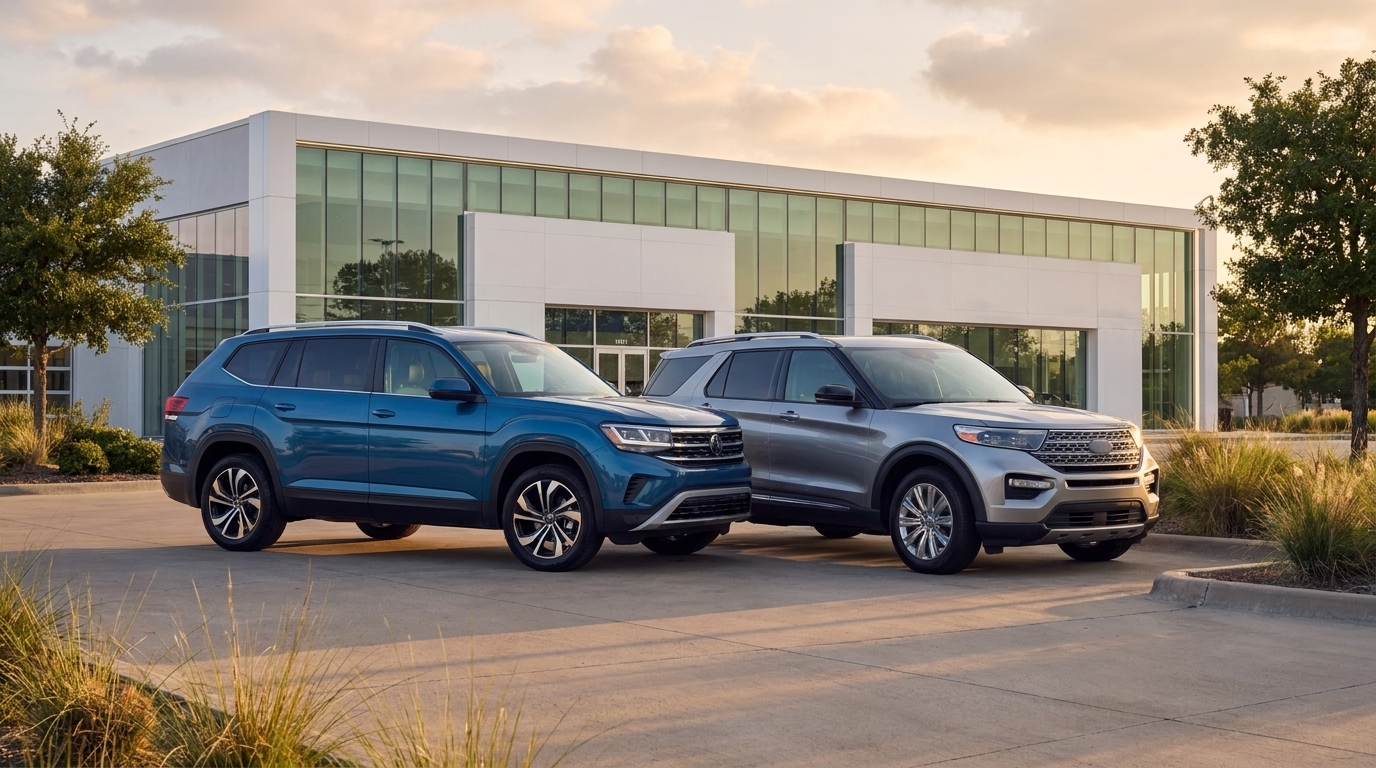
If you're cross-shopping the 2026 Volkswagen Atlas and the 2026 Ford Explorer purely on size, the Atlas is the bigger family hauler. It offers 96.6 cubic feet of maximum cargo volume, 20.6 cubic feet behind the third row, and 37.6 inches of third-row legroom — measurably more space in every cargo and rear-seat dimension. The Explorer counters with slightly more front and second-row legroom and a stronger engine lineup, but if roominess is the deciding factor, the Atlas wins the size comparison.
Below is a spec-by-spec breakdown of how these two three-row SUVs actually measure up, written for Cypress, TX shoppers who need real numbers before test-driving.
How do the Atlas and Explorer compare on cargo space?
The 2026 Volkswagen Atlas offers 20.6 cubic feet of cargo behind the third row and 96.6 cubic feet with the seats folded. The 2026 Ford Explorer offers 16.3 cubic feet behind the third row. That gives the Atlas a 4.3 cubic-foot advantage in daily-use cargo space and a substantially larger maximum cargo hold for road trips, Costco runs, and moving day.
For families in Cypress juggling car seats, sports gear, and grocery runs to the Barker Cypress or Fry Road corridors, that behind-the-third-row difference is the number that matters most. It's the space you actually use every day without folding seats down. The Atlas gives you a genuine cargo bay behind row three; the Explorer's is closer to a deep trunk.
| Cargo Dimension | 2026 VW Atlas | 2026 Ford Explorer |
|---|---|---|
| Behind 3rd row | 20.6 cu ft | 16.3 cu ft |
| Maximum (seats folded) | 96.6 cu ft | Varies by source |
| Fuel tank | 18.6 gal | 17.9 gal |
Which SUV has more third-row legroom?
The Atlas has significantly more third-row legroom — 37.6 inches versus the Explorer's 32.2 inches. That's a 5.4-inch advantage, which translates directly to adult-friendly third-row seating in the Atlas versus a tighter, kids-mostly third row in the Explorer. If you regularly carry teenagers, grandparents, or carpool groups, the Atlas is the more usable seven-seater.
Volkswagen Cypress carries the full 2026 Atlas lineup at its Cypress, TX showroom, and the third-row difference is the single spec most families notice on a back-to-back walk-through. Climbing into row three is the honest test — the Atlas simply gives passengers back there more room to sit like humans, not fold into origami.
How does front and second-row space compare?
The Explorer edges out the Atlas in the first two rows. Front legroom measures 43.0 inches in the Explorer versus 41.7 in the Atlas, and second-row legroom is 39.0 inches versus 37.6. Both are small differences that most drivers won't notice day to day, but tall drivers or families who spend the most time in row two may prefer the Explorer's front-cabin stretch.
Total passenger volume tilts the other way: the Atlas measures 153.7 cubic feet versus the Explorer's 152.9 — nearly a wash on paper, but consistent with the pattern of the Atlas distributing its interior more evenly across all three rows rather than concentrating it up front.
Which is the biggest family SUV for 2026 between these two?
The 2026 Volkswagen Atlas is the roomier of the two three-row SUVs on nearly every space-related measurement — cargo behind row three, maximum cargo, third-row legroom, total passenger volume, and fuel tank capacity. The Explorer wins on horsepower, front legroom, and second-row legroom. For pure size and family utility, the Atlas is the biggest of the two.
Both seat seven passengers as standard. Both are rated at 5,000 pounds of maximum towing capacity. Where they diverge is philosophy: the Atlas is engineered around interior packaging, while the Explorer prioritizes powertrain range and trim variety.
What about engines, trims, and pricing in Cypress, TX?
The Atlas uses a single turbocharged 2.0L TSI inline-4 producing 269 horsepower and 273 lb-ft of torque, with a starting MSRP of $39,310 across five trims. The Explorer offers a 2.3L EcoBoost making 300 hp (or an available 3.0L twin-turbo V6 with 400 hp on ST and select trims) across six trims, starting between $40,260 and $40,465. The Atlas is roughly $950 to $1,155 cheaper to enter.
Fuel economy is close: 23 mpg combined FWD or 21 mpg combined AWD for the Atlas, and 21–24 mpg combined for the Explorer depending on trim and engine. In the hot, stop-and-go traffic between Cypress and the Energy Corridor along 290, both will land in the low-20s in real-world driving. Actual EPA figures should be confirmed for the exact configuration you're considering.
How does the warranty compare?
Volkswagen provides a 4-year/50,000-mile basic warranty on the 2026 Atlas. Ford provides a 3-year/36,000-mile basic warranty on the 2026 Explorer. That's a full year and 14,000 additional miles of basic coverage on the Atlas — a meaningful difference for buyers planning to keep the vehicle past the typical financing term or through Cypress ISD's school-year commuting patterns.
Where does Volkswagen Cypress fit into this decision?
Volkswagen Cypress is the local VW dealership serving the Cypress, TX area along the 290 corridor, carrying the full 2026 Atlas lineup — SE, SE with Technology, Peak Edition, SEL, and SEL Premium R-Line.
If you're specifically weighing size and cabin space, an in-person walk-around at the Cypress showroom is the fastest way to feel the third-row difference the spec sheet describes.
Frequently Asked Questions
Is the VW Atlas bigger than the Ford Explorer?
Yes, on most measurements. The 2026 Atlas has 20.6 cubic feet of cargo behind the third row versus 16.3 for the Explorer, 96.6 cubic feet of maximum cargo volume, 37.6 inches of third-row legroom versus 32.2, and 153.7 cubic feet of total passenger volume versus 152.9. The Explorer is larger only in front and second-row legroom.
How many people does each SUV seat?
Both the 2026 Volkswagen Atlas and the 2026 Ford Explorer seat seven passengers as their standard configuration. Seating specifics can vary by trim on the Explorer, so buyers should confirm the exact configuration for the trim they're considering. Both offer a three-row layout with a bench or captain's-chair second row depending on trim.
Which has more horsepower, the Atlas or the Explorer?
The Ford Explorer has more horsepower. Its standard 2.3L EcoBoost engine produces 300 hp, and the available 3.0L twin-turbo V6 on ST and select trims produces 400 hp. The 2026 Atlas uses a single turbocharged 2.0L TSI inline-4 producing 269 hp. The Explorer also produces more torque — 310 lb-ft standard versus the Atlas's 273 lb-ft.
What is the starting price for each SUV in 2026?
The 2026 Volkswagen Atlas starts at $39,310 MSRP. The 2026 Ford Explorer starts between $40,260 and $40,465 MSRP depending on trim configuration. That makes the Atlas roughly $950 to $1,155 cheaper to enter before options, packages, dealer add-ons, or regional incentives. Actual transaction prices in Cypress, TX may differ based on inventory and current offers.
Which is better for towing?
Both the 2026 Atlas and 2026 Explorer are rated at a maximum towing capacity of 5,000 pounds, based on the comparison data. That's enough for a small camper, jet skis, or a mid-size utility trailer — common needs for Cypress families heading to Lake Conroe or Galveston. Neither has a towing advantage over the other at their rated maximums.
Which SUV has the longer warranty?
The 2026 Volkswagen Atlas has the longer basic warranty at 4 years or 50,000 miles. The 2026 Ford Explorer's basic warranty is 3 years or 36,000 miles. That gives Atlas buyers an extra year and 14,000 additional miles of basic coverage — a meaningful gap if you plan to keep the vehicle through a full financing term or beyond.
The bottom line for Cypress, TX shoppers
If your top priority is space — cargo behind the third row, adult-usable third-row seating, and maximum haul capacity — the 2026 Volkswagen Atlas is the clearer choice between these two. If you want more horsepower, a broader trim lineup, and marginally more front-cabin room, the Ford Explorer earns the look. Both are legitimate seven-seat family SUVs; they simply optimize for different things.
Readers in Cypress, TX who want to see the Atlas measurements in person, compare trims, or test the third row with actual passengers can reach Volkswagen Cypress at https://www.vwcypress.com to schedule a walk-through.